
Class 7 Worksheet on Internal vs External Conflict

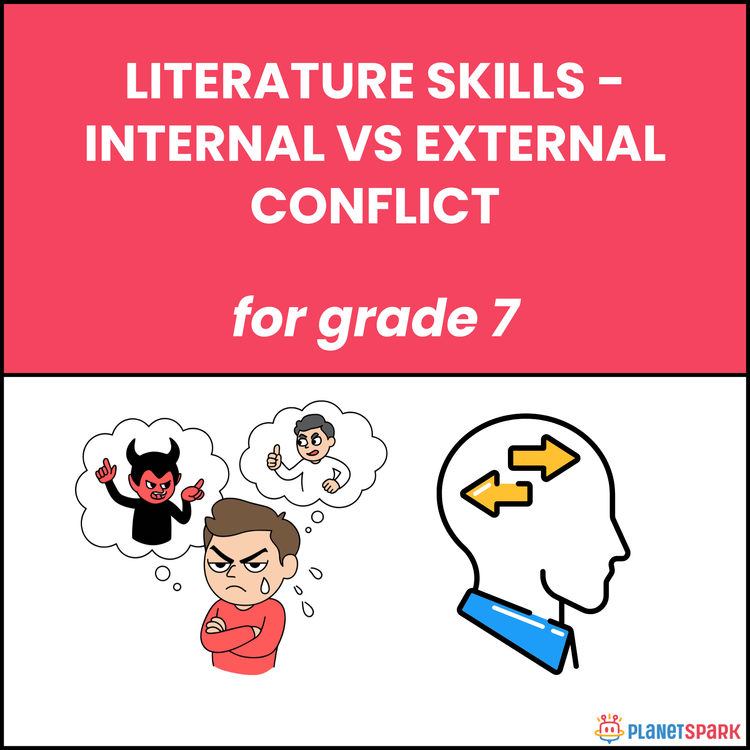
Class 7 Worksheet on Internal vs External Conflict
Inside Out: Understanding Internal vs External Conflict for Class 7
This Grade 7 literature worksheet helps students master the essential difference between internal conflict (happening inside a character's mind, such as fear, guilt, or difficult decisions) and external conflict (happening outside the character, such as fighting another person, nature, or society). Through engaging activities like multiple-choice questions, fill-in-the-blanks, true/false statements, sentence analysis, and paragraph writing, learners discover how these two types of conflict work together to create tension, build character, and make stories more meaningful. By learning to identify conflicts like "man vs self," "man vs man," "man vs nature," and "man vs society," students become sharper, more analytical readers prepared for advanced literary analysis in middle school and beyond.
Why Internal vs External Conflict Matters in Literature?
For Grade 7 learners, understanding the two types of conflict unlocks the engine of storytelling. This topic is important because:
1. Internal conflict happens inside the character's mind—struggles with fear, guilt, doubt, or hard decisions (man vs self).
2. External conflict involves outside forces—other people (man vs man), nature (man vs nature), or society/rules (man vs society).
3. These two conflicts often work together: an external problem can cause internal struggle, and internal struggle can lead to external fights.
4. When both conflicts happen at once, the story feels more real, meaningful, and the character's journey becomes more interesting.
What's Inside This Worksheet?
This worksheet includes five carefully designed activities that build a lasting understanding of internal vs external conflict:
🧠 Exercise 1 – Multiple Choice Questions
Students select the correct answer from three options, covering core concepts such as how internal conflict happens inside a character's mind, how fighting a monster is external conflict, how making a difficult decision is internal conflict, and how both types create tension in a story.
✏️ Exercise 2 – Fill in the Blanks
Students complete key sentences using their understanding of core concepts, such as "Internal conflict happens inside the character's mind" and "Man vs nature includes earthquakes and floods."
✅ Exercise 3 – True and False
Students evaluate 10 statements to identify common misconceptions (e.g., "Internal conflict happens between two characters" is false) and reinforce correct knowledge about how external conflict can cause internal conflict and how both types help readers understand the character.
📖 Exercise 4 – Identify the Conflicts
Students read 10 sentences, each containing both an internal conflict (inside the character's mind) and an external conflict (outside force). For each, students identify the external conflict and the internal conflict.
📝 Exercise 5 – Paragraph Writing (Fill in the Blanks)
Students complete a guided paragraph about internal vs external conflict using a word bank (scared, society, decision, real, external, guilty, internal, external, both, meaningful). This reinforces vocabulary and demonstrates how both types of conflict work together.
✅ Answer Key (For Parents & Educators)
Exercise 1 – Multiple Choice Questions
1. b) Internal
2. b) external
3. a) internal
4. a) External
5. b) internal
6. c) external
7. c) external
8. a) internal
9. a) external
10. b) tension
Exercise 2 – Fill in the Blanks
1. mind
2. person / character
3. nature
4. society
5. guilty
6. decision
7. guilt
8. external
9. monster / enemy / person
10. external
Exercise 3 – True and False
1. False 2. True 3. True 4. False 5. True
6. False 7. False 8. True 9. True 10. True
Exercise 4 – Identify the Conflicts
Riya wanted to tell the truth but feared losing her friend.
Internal Conflict: "but feared losing her friend" (Underlined)
External Conflict: "wanted to tell the truth" (Circled)
Meera argued with her brother while feeling guilty inside.
Internal Conflict: "feeling guilty inside" (Underlined)
External Conflict: "argued with her brother" (Circled)
Vikram climbed a cliff while his mind screamed at him to give up.
Internal Conflict: "his mind screamed at him to give up" (Underlined)
External Conflict: "climbed a cliff" (Circled)
Deepak escaped a fire while blaming himself for starting it.
Internal Conflict: "blaming himself for starting it" (Underlined)
External Conflict: "escaped a fire" (Circled)
Raj fought the bully but wondered if fighting was wrong.
Internal Conflict: "wondered if fighting was wrong" (Underlined)
External Conflict: "fought the bully" (Circled)
A storm trapped Ravi on the mountain as he doubted his skills.
Internal Conflict: "doubted his skills" (Underlined)
External Conflict: "A storm trapped Ravi on the mountain" (Circled)
Kunal raced the clock but questioned if winning mattered.
Internal Conflict: "questioned if winning mattered" (Underlined)
External Conflict: "raced the clock" (Circled)
Priya argued with her parents and felt torn between obeying and being free.
Internal Conflict: "felt torn between obeying and being free" (Underlined)
External Conflict: "argued with her parents" (Circled)
Asha faced a flood while deciding whether to save her pet or her book.
Internal Conflict: "deciding whether to save her pet or her book" (Underlined)
External Conflict: "faced a flood" (Circled)
Anjali disagreed with the whole class but worried she might be wrong.
Internal Conflict: "worried she might be wrong" (Underlined)
External Conflict: "disagreed with the whole class" (Circled)
Exercise 5 – Paragraph Writing (Fill in the Blanks)
Most good stories have two kinds of conflict. Internal conflict happens inside the character's mind. The character struggles with fear, guilt, or a hard decision. External conflict happens outside the character. The character fights another person, nature, or society. These two conflicts often work together. An external problem can cause an internal struggle. For example, a character who is lost in a forest (external) might feel scared. An internal problem can also cause an external fight. A character who feels guilty might pick a fight with a friend. When both conflicts happen at once, the story feels more real. The character must solve problems outside and both inside. This makes the character's journey more interesting and meaningful.
Help your child understand the battles inside and outside every character—unlocking the heart of every story with a Free 1:1 Literature Skills Trial Class at Planet Spark.
🔖Book a free trial!
Frequently Asked Questions
Internal conflict occurs within a character’s mind, while external conflict is a struggle between a character and an outside force.
Internal conflicts shape a character's growth by challenging their beliefs, desires, and emotions.
Yes, many stories feature both types of conflict, with the internal struggle influencing how a character faces external challenges.