
Class 6 Antonyms in Paragraph Editing Worksheet

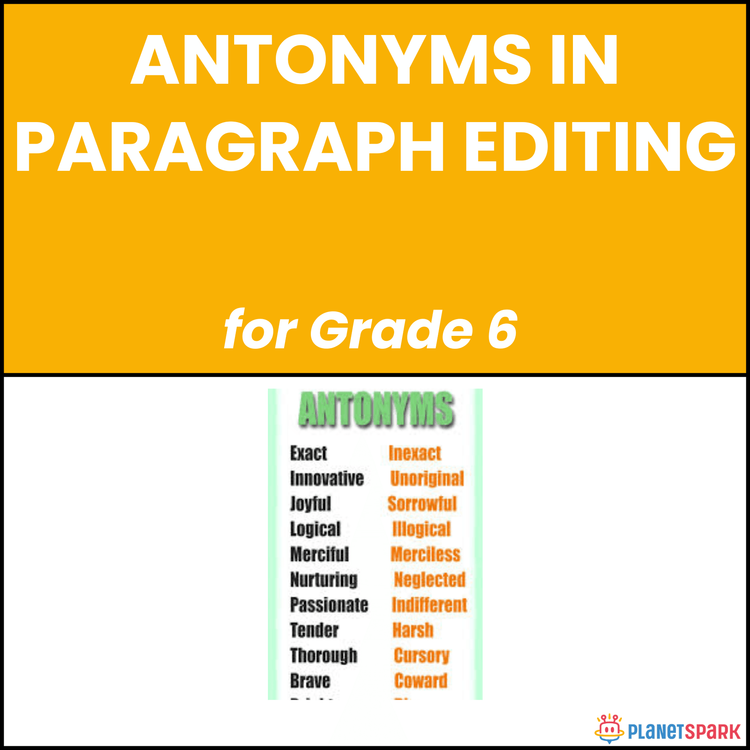
Class 6 Antonyms in Paragraph Editing Worksheet
Fix and Flip Meaning: Antonyms in Paragraph Editing for Class 6
This Grade 6 worksheet helps students master antonyms through paragraph editing and contextual sentence correction. Learners identify incorrect opposites, choose suitable antonyms, and rewrite sentences to improve meaning and clarity in real-life contexts.
Why Antonyms Matter in Grammar?
Antonyms help students understand contrast and meaning in language. For Grade 6 learners, this topic is important because:
1. It improves sentence accuracy by correcting meaning errors.
2. It strengthens vocabulary through contextual learning.
3. It develops editing and proofreading skills.
4. It enhances reading comprehension and logical thinking.
What’s Inside This Worksheet?
This worksheet includes five structured exercises designed for practical grammar application:
Exercise 1 – True or False
Students identify whether the given sentences correctly use antonyms in context.
Exercise 2 – Sort the Words
Students classify word pairs into antonyms and not antonyms based on meaning.
Exercise 3 – Fill in the Blanks
Students choose the correct antonym from given pairs to complete sentences meaningfully.
Exercise 4 – Multiple Choice Questions
Students select the correct antonym to replace highlighted words in context.
Exercise 5 – Sentence Rewriting
Students rewrite sentences by replacing highlighted words with correct antonyms to improve meaning.
Answer Key (For Parents & Educators)
Exercise 1 – True / False
1. True
2. False
3. False
4. True
5. False
6. True
7. False
8. True
9. False
10. False
Exercise 2 – Sort the Words
Antonyms:
full / empty
easy / difficult
open / closed
wide / narrow
big / small
bright / dark
tall / short
fast / slow
happy / sad
quiet / noisy
Not Antonyms:
small / little
begin / start
quick / fast
early / soon
light / bright
Exercise 3 – Fill in the Blanks
1. closed
2. easy
3. empty
4. dark
5. narrow
6. simple
7. slow
8. empty
9. closed
10. moving
Exercise 4 – Multiple Choice Answers
1. b) difficult
2. d) closed
3. a) empty
4. c) dark
5. b) narrow
6. d) complex
7. a) fast
8. c) full
9. a) open
10. a) tall
Exercise 5 – Rewritten Sentences
1. In class, the problem was difficult for everyone to solve.
2. At home, the room was dark in the evening.
3. At the market, the shop was closed early in the morning.
4. In the park, the ground was empty of people.
5. On the road, the lane was narrow and comfortable.
6. In school, the test was complex for most students.
7. During travel, the train was slow and on time.
8. In the bag, it was full after the trip.
9. At night, the sky was dark with stars.
10. At the gate, it was closed for visitors.
Build your child’s confidence in editing and vocabulary with this engaging antonym practice worksheet designed for real-life language use.
Frequently Asked Questions
Antonym usage in paragraph editing involves replacing words with their correct opposites to fix meaning and improve clarity in a passage.
It helps students identify incorrect word choices and improve sentence meaning, making their writing more accurate and effective.
Students can practice spotting meaning errors and replacing words with suitable opposites while keeping the paragraph logical and clear.